

Key Takeaways
- An AI Agent goes beyond conversation and takes independent action
- Autonomous AI systems can plan, decide, and execute tasks on their own
- This shift turns AI from being a tool to a responsible digital worker
- Early adopters of autonomous AI agents gain a real operational edge
- Understanding how AI agents work is now essential, not optional
Nothing wrong with saying that ChatGPT changed how people interact with artificial intelligence. It made AI conversational, accessible, and genuinely useful for everyday tasks. Yet, for all its intelligence, ChatGPT remains just a reactive tool. To put it simply, it waits for prompts, responds, and then stops.
AI agents mark a quiet but powerful shift. An AI agent not only responds, but also works toward an outcome. It can decide what to do next, use tools, and continue operating without constant human input. This move from conversation to execution is why autonomous AI is being called the most important shift after ChatGPT.
What Is an Agent in AI? A Simple, Practical Definition
So, what is an agent in AI, really? In principle, an AI agent is a system designed to achieve a goal independently. For instance, you provide the objective, and the agent figures out the steps needed to reach it.
Unlike traditional AI tools, an AI agent can plan actions, interact with software, store memory, and adapt when something changes. The defining ability is autonomy. An autonomous AI agent doesn’t wait for your next command, but it decides what should happen next and moves forward on its own. It’s much like a digital worker operating inside a system.
AI Agent vs ChatGPT:
Why the Difference Matters (here we need an illustration-type image, or an image depicting the workflows of both AIs)
ChatGPT is excellent at helping humans think as it explains, writes, and brainstorms with impressive clarity. But once it answers a prompt, its job gets done. It never automatically reaches the outcome, except for providing a response.
A ChatGPT AI agent, by contrast, is designed to continue working toward a result. Instead of answering one question at a time, agents break down goals, sequence tasks, and execute them across tools and platforms.
In simple terms, ChatGPT supports decisions, while AI agents help complete them. That’s the main difference why this shift is structural, not incremental.
Why Autonomous AI Is the Biggest Shift After ChatGPT
The real power of autonomous AI lies in ownership, not speed. ChatGPT accelerates individual tasks, whereas an autonomous AI agent takes responsibility for entire workflows.
As an AI agent can research, make decisions, act, and refine its approach itself, the economics of digital work change. The tasks that once required constant oversight can now run independently, earning you the peace of mind.
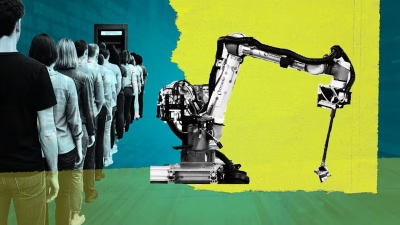
This is similar to how automation reshaped manufacturing processes: except this time, it’s happening in cognitive and digital labour. That’s why AI agents are redefining how modern businesses operate.
Real-World Examples of AI Agents in Action
A range of different AI agents is already being used across industries. For instance, marketing agents manage campaigns and adjust strategies automatically. Other examples include research agents, customer support agents, development agents, and the list goes on.
What ties these examples together is end-to-end ownership. Means that instead of just a single step, each AI agent handles a complete loop. This is why companies that adopt the best autonomous AI agents early are not only seeing a reduced workload but also higher output. This isn’t experimental anymore, but it’s operational.
The Technology Behind Autonomous AI Agents
Unlike ChatGPT, an autonomous AI agent is powered by more than just a language model. It combines reasoning systems, planning logic, memory layers, and tool integrations.
The real breakthrough is connectivity, as the agents can interact with browsers, databases, APIs, and internal software. The agentic memory allows them to track progress, while the feedback loops help them improve decisions over time.
Together, these components turn agent AI from something you can only talk to into something that actually operates inside real systems.
Pro Tip : Clear Objectives Unlock AI Agent Performance
AI agents perform best when goals are specific. Instead of focusing on tasks, define results. This allows autonomous AI agents to plan intelligently and act reliably.
Risks, Limits, and Responsible Use of AI Agents
Despite their power, AI agents cannot be labeled as flawless. Things like poor data, unclear permissions, or weak oversight can lead to mistakes. This means that as the autonomy increases, the security and ethical concerns are also growing in parallel.
The solution doesn’t lie in quitting these agents altogether, but controlling them properly. The constraints, like human review, permission limits, and monitoring systems, keep autonomous AI safe and effective.
To make the most out of these agents without sacrificing security, the best approach is to treat them like capable junior operators: productive, but supervised.
Pro Tip: Start Small Before Scaling Agent AI
The smartest teams don’t deploy full autonomy immediately. Let your AI agent prove reliability before increasing responsibility because sustainable autonomy grows step by step.
Final Thoughts: Why AI Agents Truly Matter
So far, we have discussed what’s working at the core of the AI agents and how they differ from ChatGPT. Actually, that difference defines the next chapter of artificial intelligence.
As autonomous AI agents become more capable, intelligence shifts from being assistive to being actionable. Those who understand this early won’t just use AI as a separate tool to automate tasks, but they’ll design workflows around it. This transformation isn’t coming in the future. It’s already reshaping how digital work gets done.