

Google’s New AI Detector Just Went Public and It’s Not What Anyone Was Expecting

October 7, 2026. Google quietly opens SynthID Detector to the entire world, no waitlist, no press pass needed. You just go to synthid.com, drop a file in, and wait. Within hours, the tech press had declared that Google cracked AI detection. They hadn’t. And neither had Google.
Here’s what actually happened, and why the gap between what this tool does and what people think it does matters more than the launch itself.
Before you run anything through the detector, get this straight: a “no watermark detected” result doesn’t mean the file is real. It means the file wasn’t made with a watermarked AI tool. Those aren’t the same thing.
What Google Just Launched and Why Everyone Is Talking About It
SynthID has been Google’s internal watermarking system since 2023. Every time one of their AI models (Gemini for text, Imagen for images, Veo for video, Lyria for audio) creates something, it quietly bakes an invisible mark into the pixels or sound waves right at the moment of creation. You can’t see it. You can’t hear it. But software built to look for it will find it.
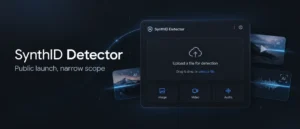
For the first year, the detection side of this was locked down: invite-only, handed out to a handful of journalists and researchers. Then in May 2026, OpenAI, NVIDIA, and Kakao joined the SynthID ecosystem, which meant content from ChatGPT and DALL-E started carrying the same mark. On October 7, the tool went fully public. Apple’s reportedly joining soon.
The numbers Google shared are genuinely striking: over 180 billion images and videos watermarked since 2023, plus 240,000 years’ worth of audio. Their built-in detection across Search, Gemini, and Chrome already fields more than a million requests a day. That’s real infrastructure. What’s worth asking is what it’s actually built to do.
What the Tool Actually Does and It’s Not What Most People Think
This is where the gap opens up.
SynthID Detector doesn’t look at a file and decide if it “looks AI.” It doesn’t hunt for the telltale mistakes: the weird fingers, the blurred backgrounds, the skin that’s too smooth. It does exactly one thing: checks whether a file contains the SynthID watermark. Find the watermark, and you know a compatible AI tool made it. Find nothing, and you know almost nothing at all.
The tool says this plainly in its own FAQ: “This is not a general AI detector. We can only detect media from the above companies, who have adopted SynthID technology.”
That’s not a caveat buried in the fine print. It’s the whole point.
How Does SynthID Work Under the Hood
The synthid watermark gets baked in during generation, not stamped on afterward. For images, SynthID tweaks individual pixel values by amounts your eye would never catch. For audio, it nudges certain frequencies ever so slightly. Video gets processed frame by frame. Because the mark is embedded at the source, it holds up through basic edits: compression, resizing, filters. Heavy compression can degrade the signal though, so running the highest-quality version of a file through will give you the best shot at detection.
What a No Watermark Result Actually Means
This is the part worth really sitting with. When PCWorld ran the tool on AI-generated content right after launch, it came back with “no watermark found” on material it had no business flagging, because that content came from tools outside the SynthID network. Not wrong. Just narrow.
A missing watermark could mean the file is real. It could also mean it was made in Midjourney, Stable Diffusion, Grok, or any of hundreds of open-source generators that have no connection to this system whatsoever.
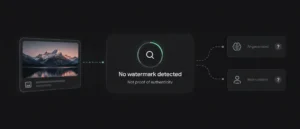
Think of SynthID like a passport stamp. The stamp tells you someone went through a specific checkpoint. No stamp tells you nothing about where they’ve been.
Which AI Tools Does It Detect and Which Does It Miss
Right now the tool covers Google’s own lineup (Gemini, Imagen, Veo, Lyria), OpenAI’s image tools (DALL-E, ChatGPT image generation), NVIDIA’s Cosmos models, and Kakao. ElevenLabs came on board in May 2026 for audio. Apple is next.
Everything outside that circle is invisible to it. The most popular open-source image generators, most AI video tools, anything that predates SynthID integration. None of it shows up. When people picture a “google ai detector,” they’re usually imagining something that catches AI content everywhere. That’s not this.
And that’s not a design flaw. As Google’s own docs put it, building something universal “takes time” and would need watermarking, metadata standards, and verification to line up across the whole industry. That doesn’t exist yet, and no single company is going to build it alone.
Worth noting: Google still hasn’t published detection accuracy numbers or false-negative rates. For anyone thinking about folding this into a serious content verification workflow, that gap matters.
Who Actually Needs This Tool
Fewer people than the launch coverage suggested. The ones who do need it really need it.
If You’re a Journalist or Fact-Checker
This is genuinely useful for you. When a suspicious video surfaces and you need a fast first pass, uploading it here tells you quickly whether it came from a SynthID-compatible tool. A positive hit is meaningful: it narrows the origin and gives you somewhere to investigate before you publish. For newsrooms handling volume, that’s a real filter worth having.
If You’re an Everyday User
Use it, but with your eyes open. Got a suspicious image someone sent you? Worth running it through. A positive detection actually tells you something. A negative result just means the specific watermark wasn’t there. Treat it as one more data point, not a green light.
Run it as one check, not the only check. Pair it with reverse image search, source verification, and publication metadata before you make any calls based on the result.
The Bigger Picture: Why One Detector Will Never Be Enough
The real story here isn’t the tool. It’s that Google, OpenAI, NVIDIA, and Kakao are now operating on the same watermark standard. That’s the architecture for something much bigger, and every new partner that joins widens what can actually be verified. Calling this an ai watermark detector that covers only part of the internet is fair. The part it covers is growing.
The EU AI Act, which kicked in August 2026, now requires labeling of synthetic content. Google signed the EU AI Act Code of Practice on AI Content Transparency and cited SynthID in its compliance approach. That regulatory push will keep pulling more companies into compatible standards.
Realistically, that takes years. Until then, SynthID Detector is worth using for what it’s actually built for, and worth understanding clearly for what it isn’t.
Final Thoughts
Google’s new AI detector is a real tool doing a real job for a specific audience. It’s not magic, it won’t catch everything, and a clean result isn’t a verdict on authenticity. What it does is genuinely useful: identifying content watermarked by four of the biggest AI providers on the planet, as long as you know exactly what you’re asking it.
The launch matters less as a product moment than as a signal: parts of the industry are starting to agree on shared infrastructure for content provenance. Slowly, imperfectly, incompletely. But it’s happening.
Frequently asked questions
SynthID Detector is a free public tool from Google DeepMind at synthid.com. It checks whether an image, video, or audio file carries an invisible provenance mark embedded during AI generation. It covers content from Google, OpenAI, NVIDIA, and Kakao. It's not a general AI detector. It only works on content from companies that have built in SynthID technology.
No. It only covers content from AI tools that have adopted the SynthID system. Midjourney, Stable Diffusion, Meta's AI tools, and most open-source generators won't trigger a detection. Not because they're undetectable in principle, but because they're outside the partner network.
It means no compatible mark from a supported partner was detected. Nothing more. It doesn't confirm the content is real, human-made, or trustworthy. Absence of a signal is not evidence of authenticity.
Images: JPG, PNG, HEIC, GIF. Video: MP4, MOV, WEBM. Audio: MP3, WAV, FLAC. Text isn't supported yet. Upload the highest quality version you have, because heavy compression can weaken the watermark.
Yes, fully free at synthid.com in English, globally. You'll need to sign in with a Google, Apple, or OpenAI account to use the upload feature.
Related posts

How to claim and optimize your AI Dust listing
Claiming takes two minutes. Optimizing it properly takes a bit longer — here's where to start.
Read more
Buy the tool or build your own? A practical build or buy framework for businesses choosing AI
A practical guide to help businesses decide whether to buy AI tools, build custom systems, or combine both for better results at scale.
Read more
Put Deterministic Systems Before Generative Explanations
If a product must return the same answer when given the same facts and rules, do not ask a language model to invent that answer.
Read more