

Key Takeaways
- AI is taking over tasks faster than it is eliminating entire jobs.
- Most AI job replacement data points toward job transformation, not mass unemployment.
- Some jobs will be replaced by AI, but many more are being reshaped or newly created.
- AI is already changing how companies hire, screen, and manage talent.
- The future favors AI-proof careers that combine human judgment with AI tools.
Few questions create as much anxiety today as this one: Is AI taking over jobs? In fact, the headlines about robots taking over jobs and AI replacing human jobs have made it feel like a countdown has started.
But when you look past the fear and into the data, a more nuanced picture appears.
This article breaks down what is actually happening in the labor market, how many jobs AI has replaced so far, which jobs AI will replace next, and why AI is not simply eliminating work but reshaping it. We’ll understand where the risk is actually real, where it is exaggerated, and how humans still fit into the future of artificial intelligence.
Let’s start with the core question.
Is AI replacing jobs or changing how work is done?
The short answer is this: AI is replacing tasks, not humans.
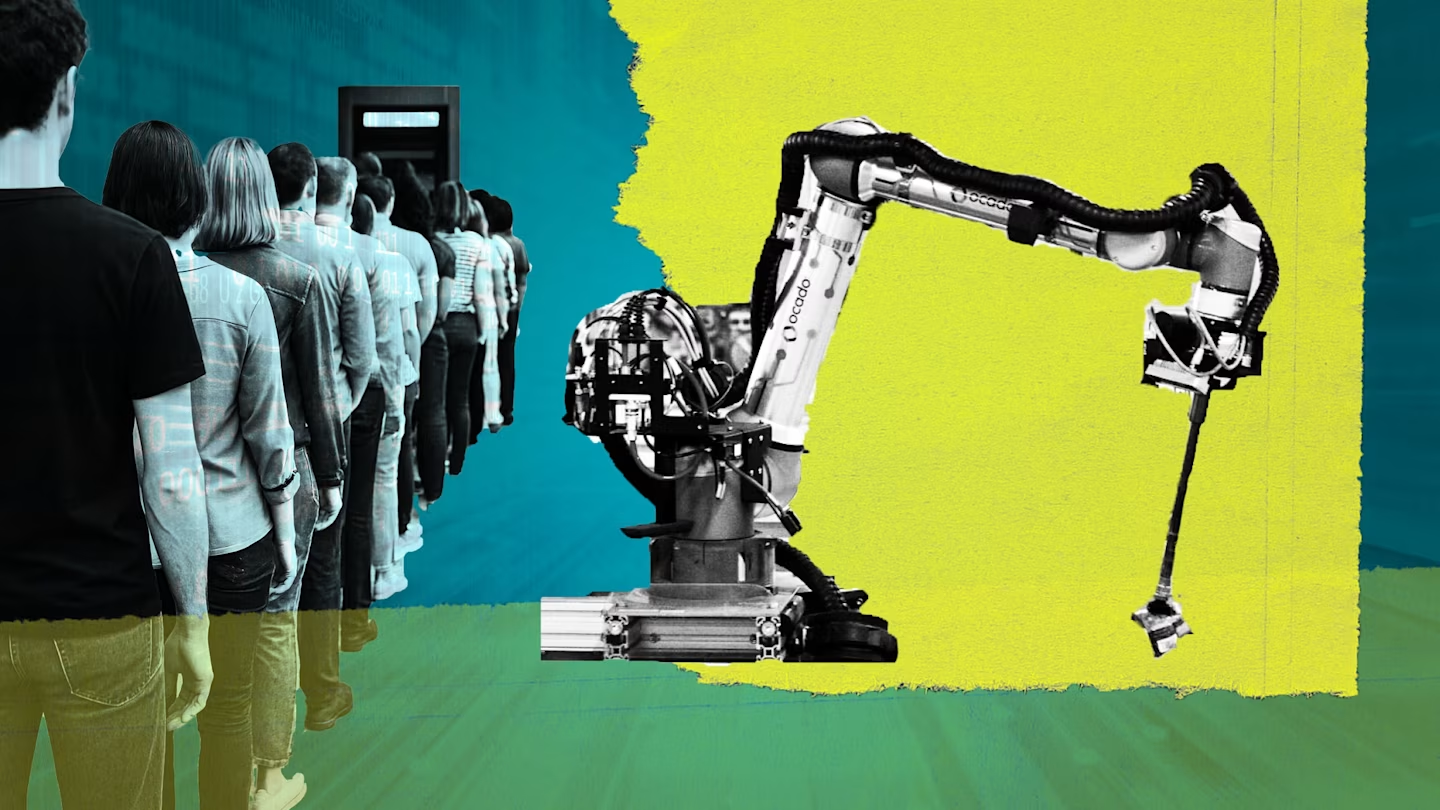
Most AI replacing jobs statistics show that AI job displacement happens at the task level. Routine, repetitive, and rules-based work is being automated in the first place. Entire occupations rarely disappear overnight.
Research across industries shows that even in roles that are highly exposed to AI, the jobs are partially automated. The higher value responsibilities, such as decision making, oversight, and relationship management, are still handled by humans.
This is the reason why data does not support the idea that AI is taking over jobs all at once. In fact, companies that adopt AI often grow faster and end up hiring more people overall.
However, that does not mean AI is harmless. But it implies that the change is uneven and requires adaptation.
ONE IMAGE HERE. Required
Suggested visual: AI versus human collaboration in modern workplaces
How many jobs has AI replaced so far?
This is where context matters.
If you ask how many jobs AI has replaced globally, the honest answer is relatively few when measured as net job losses. However, millions of roles have been reshaped.
AI job displacement statistics consistently show three patterns:
- Jobs heavy on data processing and routine analysis are shrinking.
- Jobs combining technical skills with human judgment are growing.
- New roles are appearing faster than old titles disappear.
For example, the customer support jobs increasingly rely on AI chat systems, but that didn’t eliminate humans from the equation. Instead, humans now supervise, train, and handle complex cases.
Similarly, software development did not vanish due to AI coding tools, but developers now work faster and focus more on architecture and problem-solving. So when people ask whether AI is taking jobs, the correct framing is which tasks are being automated and what replaces them.
What jobs will AI replace, and which will survive?
Some jobs are clearly more vulnerable than others.
Jobs most likely to be replaced by AI
Based on current data and the future predictions about AI, the jobs that it will replace first include:
- Data entry and basic clerical work
- Simple customer service and call handling
- Routine bookkeeping and payroll processing
- Basic content moderation and tagging
- Repetitive manufacturing and assembly tasks
These roles depend heavily on predictable patterns, making them easier to automate. To put it simply, the tasks that would be based on such routine tasks are likely to be replaced.
Jobs AI is reshaping rather than replacing
Many jobs that people think would disappear are actually evolving:
- Marketing roles now rely on AI analytics but still need human strategy and creativity
- Journalists use AI for research but not for editorial judgment
- Doctors may use AI diagnostics, but do not rely on it for decisions
- Lawyers automate document review but handle reasoning and advocacy themselves
This is why the question is not just what jobs will be replaced by AI, but what jobs will change because of AI.
Job displacement due to AI: why it happens
AI job displacement happens for three main reasons:
- Cost and speed: AI can process information faster and cheaper than humans for certain tasks.
- Scale: AI systems do not tire, making them perfect for highly repetitive work.
- Data availability: Jobs built around digital data are easier to automate than physical work.
In fact, the industries that are rich in structured data are seeing faster disruption. While industries dependent on human interaction or physical environments change more slowly.
This explains why AI replacing jobs feels sudden in some sectors while barely noticeable in others.
How AI is transforming hiring and recruitment
One area where AI is clearly taking over tasks is hiring.
AI does not replace recruiters, but it replaces inefficient processes. Today, AI helps in hiring by:
- Screening resumes and shortlisting candidates
- Matching skills to job requirements
- Reducing time to hire
- Predicting retention and performance trends
For companies, this means faster and more consistent hiring. And for candidates, it means clearer skill signals matter more than credentials alone. However, for AI decisions, human oversight remains critical to avoid biased training data and unfair outcomes.
Will AI replace humans or work alongside them?
This is where fear often turns into misinformation.
AI will not replace humans in roles requiring empathy, accountability, or moral judgment. Instead, humans who know how to work with AI will replace those who do not.
This is why AI-proof careers are not those that avoid technology, but the ones that master it. Such careers usually involve:
- Decision making under uncertainty
- Cross-functional collaboration
- Ethical and strategic responsibility
- Creative problem solving
- Leadership and communication
The future of work is not AI or human, but it’s AI and human.
Is AI taking over the world?
To be honest, no. And asking when AI will take over the world distracts from the real issue. The real issue is how societies manage transition.
If workers are supported with reskilling, if companies invest responsibly, and if governance keeps pace, AI becomes a productivity booster rather than posing a threat.
Indeed, the data shows that AI is taking over. But only on tasks, not control. Actually, it now reshapes economies the way computers once did.
Final thoughts on AI and jobs
So, is AI replacing jobs?
Yes, some jobs are being replaced by AI. Yet many more jobs are being transformed by AI. And entirely new roles are emerging that did not exist a decade ago.
The question is not whether AI will take jobs. It already is. The real question is whether humans adapt faster than tasks disappear. Those who understand how AI works, where it fails, and how to use it responsibly will not be replaced. They will be the ones shaping the next generation of work.