


How Good Is Gemini 4 Carbon? Benchmarks, Access, and Real Cost

Gemini 4 Carbon is now open to pretty much everyone who pays Google for AI. It spent two weeks in a restricted preview with a handful of cybersecurity partners. On November 10, Google opened it up to paying developers, enterprises, and Ultra subscribers. Google calls it its most capable model so far, and in its launch post on X the company pitched it for “deeply complex, long-horizon workflows.”
That’s the marketing. We wanted something more useful. So we went through Google’s own benchmark claims, the independent test data, the pricing pages, and the early reactions from developers who have spent the week poking at it. The short answer is that it’s one of the smartest models you can use right now. The longer answer involves speed, token habits, and a price that doubles on December 1.
Gemini 4 Carbon Tops Google’s Own Scorecard
Start with what Google says, because the claims are specific enough to check. In the official announcement, Google says Carbon ranks first on CursorBench 4.0, on Perplexity’s WANDR agent evaluation, and on Zapier’s AutomationBench. On that last one, Google says it gets there at less than half the cost per task of the next best external model.
The partner quotes are the more interesting part. HubX says the model fixed 94% of 16 real bugs in a codebase with 14,000 tests and introduced zero regressions. Hebbia calls it the strongest model it has tested for deep financial research. On a Multimodal Knowledge Agent benchmark built with Artificial Analysis, Carbon came second, but at more than six times lower cost than the model above it.
Google also leans hard on honesty. On an internal set of 375 tasks designed to catch a model claiming it finished work it didn’t, Carbon scored 92%, compared with 70% for Argon. If you’ve ever had an agent cheerfully report “all tests passing” when nothing ran, you’ll understand why that number matters more than another leaderboard spot.
Still, these are vendor numbers and partner testimonials. Partners chosen for a launch blog post are not a random sample. So we went looking for someone who doesn’t sell the model.
What Independent Tests Say About Gemini 4 Carbon
Artificial Analysis runs every major model through the same battery of tests, and its numbers mostly back Google up. Carbon on its high thinking setting scores 60 on the Intelligence Index. That puts it fourth out of 80 models tracked, against a median of 41. For context inside Google’s own lineup, Hydrogen scores 54 and Argon scores 50. That’s a real jump, not a rounding error.
Then you scroll down, and the picture gets more complicated. Carbon is slow. Artificial Analysis clocks it at 30.9 minutes per task on average, against a median of 13.1 minutes, which ranks it 72nd out of 79 for speed. It’s also chatty. Running the full index, Carbon produced 205 million output tokens, where the median model used 77.3 million. That’s roughly two and a half times the typical output for the same set of questions.
That second number is the one to remember. Output tokens are what you pay for, and they’re the expensive half of the bill. A model that thinks out loud at that length is going to cost more in practice than its sticker price suggests
Don’t jump straight to the high thinking setting. Medium is the default, and Artificial Analysis scores it at 58 against 60 on high. For most work, that two-point gap won’t be worth the extra time and tokens. Save high for the tasks that actually fail on medium.
The Real Cost of Gemini 4 Carbon Isn’t the Sticker Price
Here’s where it gets confusing, and we’re not the only ones who think so. Simon Willison, who tracks Gemini API pricing more closely than almost anyone, put it bluntly in his notes on the release: “I’m finding Gemini 4’s pricing really confusing.”
The reason is a launch discount with an end date. Here is how the three models line up per million tokens:
| Model | Input until Nov 30 | Output until Nov 30 | Input from Dec 1 | Output from Dec 1 |
|---|---|---|---|---|
| Carbon | $2.00 | $10.00 | $4.00 | $20.00 |
| Argon | $2.00 | $10.00 | $4.00 | $20.00 |
| Hydrogen | $1.50 | $7.50 | $1.50 | $7.50 |
Cached input gets a 95% discount across the board, which helps a lot if you send the same long context over and over.
Quick math makes the change obvious. A job that uses one million input tokens and one million output tokens costs $12 today. On December 1, the same job costs $24. Nothing about the model changes. Only the bill does.
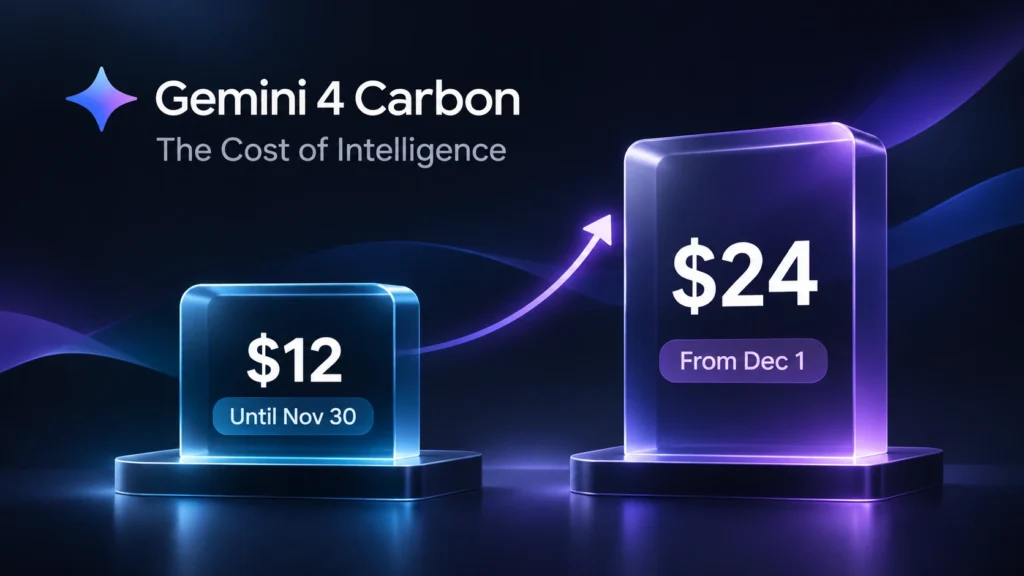
Willison also points out where that puts Carbon against the competition. At launch pricing it sits level with Claude Sonnet 5.5 and GPT-6.1 Sol. At December pricing it sits level with Claude Opus 5.5. That’s a big move from the mid tier to the premium tier in three weeks.
Now combine that with the token habits from the last section. Artificial Analysis puts the cost of running a single task on its index at $5.48. A model that writes two and a half times more than average turns a premium per-token rate into a premium per-task bill.
Budget at the December rates of $4 and $20 now. If you build a cost estimate on the launch prices, it will be wrong in a few weeks, and nobody enjoys explaining a bill that doubled overnight.
Gemini 4 Carbon vs Argon: Same Price, Different Jobs
This is the comparison that matters most for anyone deciding what to use, because the two cost exactly the same. So why would anyone pick the weaker one?
Google’s answer is that Gemini 4 Argon is the right choice for most everyday work. It’s faster, it uses fewer tokens, and it handles the bulk of chat, drafting, and routine coding without trouble. Carbon is the model you bring in for long, multi-step agent jobs where getting it right the first time matters more than getting it back quickly.
The honest framing is that Carbon scores ten points higher on Artificial Analysis, but it also takes longer and writes more. At the same per-token price, Argon will usually be the cheaper model per task simply because it says less. Pick Carbon when a failure would cost you more than the extra tokens.
There’s also a third option that most coverage skips. Hydrogen launched this week too. It powers the free Gemini tier and the AI features in Google Search. Hydrogen also outscores Argon on the index, 54 to 50. It’s a quarter cheaper than Carbon today, and after December 1 it costs well under half as much. If your work is high volume and doesn’t need the top model, start there.
Who Can Actually Use Gemini 4 Carbon
Access is narrower than the “now available” headline suggests. On the consumer side, only Google AI Ultra subscribers get it, and that plan starts at $99.99 a month in the US. Ultra members can use Carbon in the Gemini app, in AI Mode in Search, and in Antigravity, Google’s agent coding tool. Pro and free users don’t get it.
For developers, Carbon is on the paid tier of the Gemini API through AI Studio and Android Studio, under the model ID gemini-4-carbon. It’s not on the free API tier. Businesses can get it through Gemini for business plans.
Google is also running two smaller programs. Researchers in its scientists program get six months of free access. Security teams can apply to the Fairwind Program, which grew out of the original cybersecurity preview.
Before you change any production workflow, test with a paid API key in AI Studio on one real task you already know the answer to. Carbon supports a one million token context window, so use a task with real documents instead of a toy prompt. That will tell you more than any benchmark chart.
So, How Good Is It?
Very good, with a few asterisks. On independent testing, Carbon is one of the four smartest models you can use, and Google’s honesty numbers address a real problem with agent work. If you run long, complicated jobs where a wrong answer is expensive, it earns its place.
The asterisks are what most launch coverage leaves out. It’s slow. It writes a lot. And its price doubles on December 1, which moves it into the same bracket as the most expensive models on the market. For most everyday tasks, Argon or Hydrogen will do the job faster and for less. Treat Carbon as the specialist you call in, not the default you leave running.
Related posts
How to compare two AI tools for one job
To compare two AI tools honestly, you must evaluate them against one specific operational job. When an option bills against an API meter, you must.
Read more
How to Test an AI Meeting Assistant Before It Assigns Work
Test an AI meeting assistant for invented tasks, wrong owners, changed deadlines, and unsafe handoffs before automating follow-up work.
Read more
The Hidden Costs of AI Agents: Why AI Agents Are More Expensive Than You Think
Discover AI agent ROI, cost per successful task, AI workflow optimisation, and the hidden economics of running AI agents at scale.
Read more